

News Summary
Researchers at the University of Pennsylvania are developing groundbreaking methods to reduce concrete’s carbon footprint through advanced 3D printing techniques and new carbon-absorbing concrete mixtures. Their work focuses on optimizing structural designs to use less material, while also replacing a portion of traditional cement with diatomaceous earth, which enhances CO2 absorption. These innovations aim to create a path toward carbon-negative architecture, significantly lowering the environmental impact of the construction industry.
Pittsburgh – Researchers at the University of Pennsylvania are spearheading significant advancements aimed at drastically reducing the environmental impact of concrete, a material widely recognized as a substantial contributor to global climate change. Their innovative work involves both advanced 3D printing techniques to optimize structural designs and the development of novel concrete mixtures capable of actively absorbing carbon dioxide from the atmosphere. These breakthroughs also offer the potential to lessen the construction industry’s reliance on steel reinforcement, further diminishing concrete’s overall carbon footprint.
Addressing Concrete’s Climate Challenge
Concrete is an indispensable building material, used in vast quantities worldwide, second only to water in terms of consumption. However, its production, particularly the manufacturing of cement—a key binding agent—is highly carbon-intensive. The global cement industry is responsible for approximately 8% of total global carbon emissions annually. This makes it a larger emitter than the entire global aviation sector.
The primary sources of these emissions are twofold: the chemical process of heating limestone to produce clinker, known as calcination, and the burning of fossil fuels required to achieve the extremely high temperatures in cement kilns. Each ton of cement produced can generate nearly 1,400 pounds of carbon dioxide emissions. Given that around 4 billion tons of concrete were produced in 2021 alone, the scale of this environmental challenge is immense.
Innovating with 3D Printing for Material Efficiency
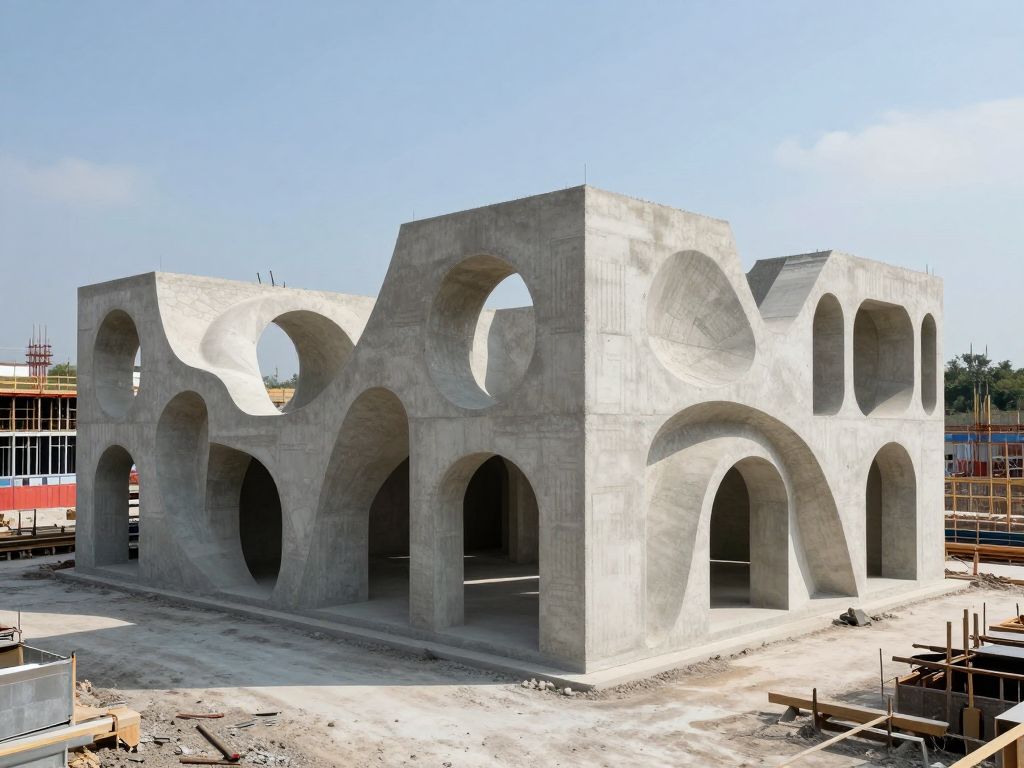
A multidisciplinary team at the University of Pennsylvania, including Professor Masoud Akbarzadeh, is tackling concrete’s footprint by rethinking structural design through 3D printing. This team is developing methods to create optimized concrete structures that require significantly less material without compromising strength. By modeling the flow of forces through architectural elements like bridges, floors, and columns, they design forms that bear weight most efficiently, leveraging concrete’s natural compressive strength.
These designs often incorporate complex geometries, such as triply periodic minimal surfaces (TPMS), inspired by structures found in nature like coral and bones. These intricate shapes maximize surface area and stiffness while minimizing the amount of material used. Testing has shown that 3D-printed concrete components utilizing these optimized designs can use up to 68% less material compared to traditional concrete blocks, while still retaining 90% of their compressive strength. Furthermore, 3D printing eliminates the need for conventional concrete forms, which often contribute to construction waste, and can reduce the requirement for steel reinforcement, making structures easier to dismantle and recycle at the end of their lifespan.
Developing Carbon-Absorbing Concrete Mixes
In parallel, another research team at Penn, led by Professor Shu Yang, is focused on creating new concrete mixtures that actively capture carbon dioxide. Their groundbreaking work involves replacing a portion of traditional cement with diatomaceous earth (DE), a sedimentary rock composed of fossilized microscopic algae.
The unique porous, sponge-like structure of diatomaceous earth is key to this innovation. It not only improves the flow behavior of concrete during 3D printing but also provides numerous sites for trapping carbon dioxide. This new mixture has demonstrated a remarkable capacity to absorb carbon, showing up to a 142% increase in CO2 uptake compared to conventional mixes. In controlled environments, this concrete absorbed 42% more carbon from the air than standard concrete within just one week. The presence of diatomaceous earth also facilitates the formation of calcium carbonate during the curing process, which further enhances both the material’s CO2 absorption capabilities and its mechanical strength.
Reducing Reliance on Steel Reinforcement
A significant benefit of these innovative concrete solutions is the potential to reduce or even eliminate the need for traditional steel reinforcement. Steel production itself is an energy-intensive process with its own environmental footprint. By developing concrete that is inherently stronger, more durable, and structurally optimized through advanced design and material composition, the Penn researchers are creating a pathway to construct buildings and infrastructure with fewer materials overall. This reduction in the need for steel reinforcement contributes to a further decrease in the embodied carbon associated with construction projects.
A Broader Vision for Sustainable Construction
These innovations represent a critical step toward transforming the construction industry, which is under increasing pressure to adopt more sustainable practices. The Penn researchers’ work contributes to a vision of carbon-negative architecture, which aims to reduce both embodied carbon—the emissions associated with material production, transport, and construction—and operational carbon—the emissions from heating and cooling buildings. By designing structures that use less material, incorporate carbon-absorbing concrete, and are geometrically optimized for passive thermal regulation, these advancements promise a future where our built environment can actively combat climate change.
Frequently Asked Questions
- What is the primary environmental concern with concrete?
- Concrete production, specifically cement manufacturing, is a major contributor to greenhouse gas emissions, accounting for approximately 8% of total global carbon emissions annually.
- How are Penn researchers reducing concrete’s carbon footprint?
- Penn researchers are using advanced 3D printing techniques to create optimized concrete structures that require less material and developing new concrete mixtures that incorporate diatomaceous earth to absorb more carbon dioxide.
- What is diatomaceous earth and how does it help?
- Diatomaceous earth (DE) is a fossil-based material derived from microscopic algae. Its porous, sponge-like structure enhances the concrete’s ability to trap CO2, improving carbon uptake by up to 142% compared to conventional mixes, and facilitates calcium carbonate formation for increased strength.
- How much CO2 can the new concrete mixture absorb?
- The new mixture, incorporating diatomaceous earth, absorbed 42% more carbon from the air than conventional concrete when placed in a carbon dioxide-rich environment for a week. It has shown up to a 142% increase in CO2 uptake compared to conventional mixes.
- How do 3D printing techniques contribute to reducing emissions?
- 3D printing allows for the creation of optimized geometries that use less concrete, potentially up to 68% less material, while maintaining structural strength. It also reduces the need for traditional concrete forms and can lessen the requirement for steel reinforcement.
- What is the benefit of reducing steel reinforcement in concrete?
- Reducing the need for steel reinforcement further shrinks the overall carbon footprint of construction, as steel production itself is an energy-intensive process with its own environmental impact.
Key Features of Penn’s Sustainable Concrete Innovations
| Feature | Description | Environmental Impact Reduction |
|---|---|---|
| Optimized 3D-Printed Geometries | Designs inspired by natural forms to maximize stiffness and surface area while minimizing material use. | Up to 68% less concrete material used while retaining 90% compressive strength. Reduces traditional formwork and steel reinforcement. |
| Diatomaceous Earth Concrete Mix | New concrete mixture incorporating diatomaceous earth (DE), a porous fossil-based material. | Absorbs up to 142% more CO2 than conventional mixes. Absorbed 42% more carbon in a week in CO2-rich environment. |
| Reduced Steel Reinforcement Need | Enhanced strength and optimized designs decrease reliance on traditional steel rebar. | Lowers the embodied carbon of construction projects by reducing the use of energy-intensive steel. |
| Carbon-Negative Architecture Potential | Holistic approach addressing both embodied and operational carbon emissions in buildings. | Contributes to passive heating and cooling through optimized thermal mass, reducing energy consumption. |
Deeper Dive: News & Info About This Topic
HERE Resources
Enhancing Your Front Yard in Philadelphia: Creative Landscaping Ideas for a Sustainable and Stylish Outdoor Space
10 Amazing Garden Design Ideas to Make Your Philadelphia Home Stand Out
Construction Projects Impact Navigation at University of Michigan
University of Pennsylvania Develops 3D Printable Concrete
Innovative Study Blends Seaweed with Concrete for Sustainability